
Public preview · Pending editorial review
The WAF bill is changing. Don't optimize away your protection.
AWS is changing WAF pricing in February 2027. The useful exercise now is to model protected resources and inspected traffic without treating security rules as disposable budget lines.
In this story

Model before changing controls
Use actual account data and validate the security impact.
- Inventory
Map protected resources and contract exceptions.
- Measure
Count inspected and advanced-protection traffic.
- Decide
Model costs and review security coverage together.
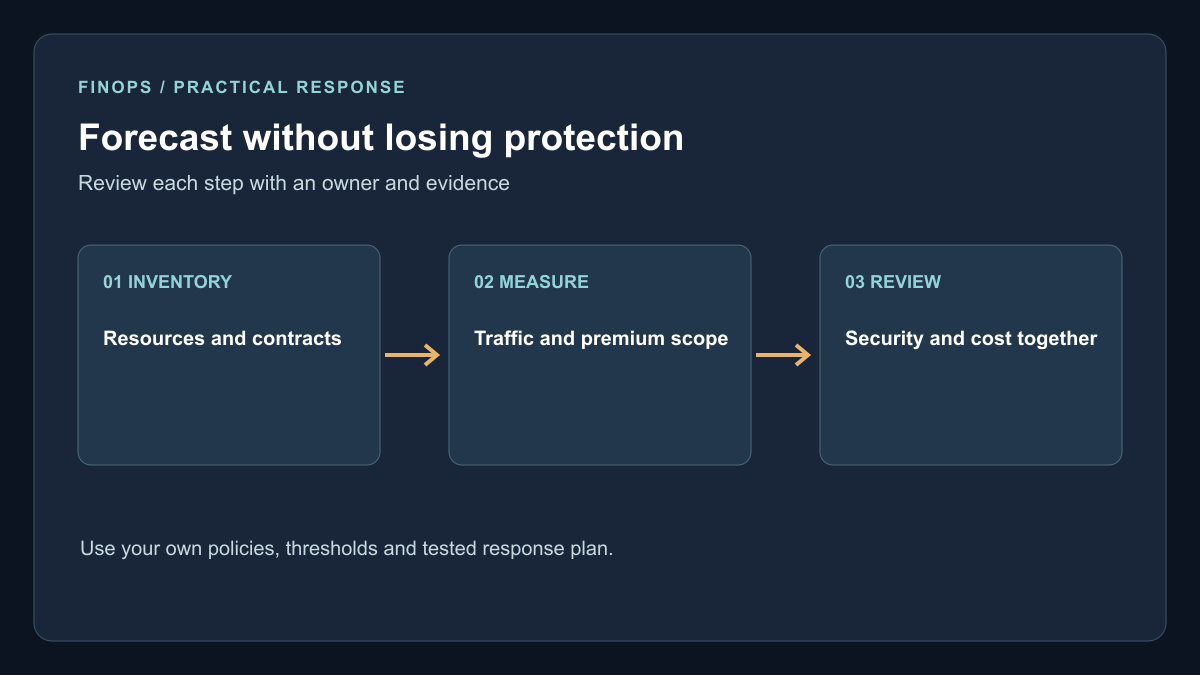
Three dimensions, one future bill
On 23 November, AWS announced WAF pricing based on protected resources, inspected requests and requests evaluated by advanced protections, effective for usage from 1 February 2027. Existing pricing continues until then. AWS says current private pricing agreements remain in force until expiry, while Shield Advanced and CloudFront flat-rate customers have specific unchanged entitlements. Check your agreement and applicable region rather than applying a generic estimate to every account. [1]
AWS describes a resource fee, a base request fee and a premium fee for requests evaluated by advanced protections. Premium is charged once per request even if multiple advanced protections evaluate it. A request inspected by two separate protection packs is billed at each one. Marketplace rule-group charges and other services may be separate. [1]
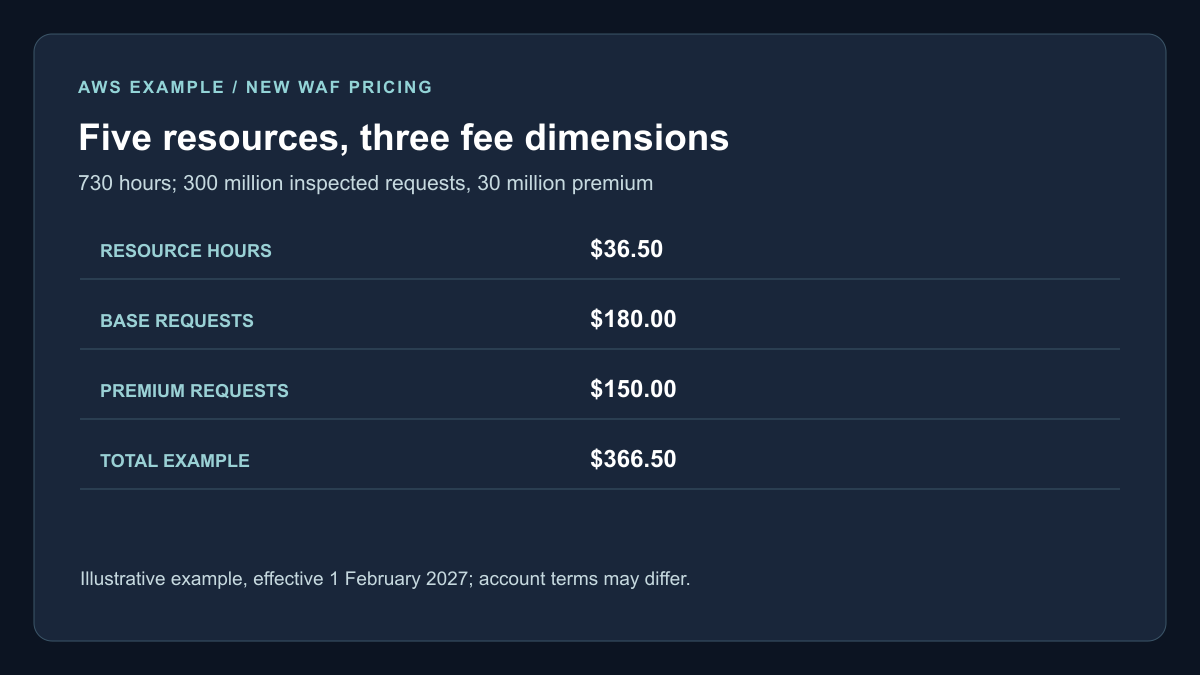
A worked estimate is not a forecast
AWS's published example uses five protected resources for 730 hours, 300 million inspected requests and 30 million requests evaluated by advanced protections: $36.50 resource charges, $180 base and $150 premium, or $366.50. It uses the published rates of $0.01 per resource-hour, $0.60 per million base requests and $5 per million premium requests. This example excludes other charges and is not your invoice. [1]
Blocked requests still count as inspected. Estimate request volume from your own telemetry, including peaks and multiple enforcement layers; then compare like-for-like against actual historical spend and contract terms. Do not assume the previous and new line items measure the same thing.
Keep the security team in the spreadsheet
A narrower scope for an advanced protection may reduce premium-evaluated requests, but it can also leave important paths unprotected. Agree threat coverage with security owners, test changes in count or observation mode where appropriate, and use your established change process. AWS says adding or changing rules alone does not change the new rate; traffic volume and protection selection still matter. [1]
The goal is an attributable forecast with a documented security trade-off, not the cheapest spreadsheet cell. A firewall that protects the budget better than the application has misunderstood its assignment.
Five checks before the change
Start with an inventory and a read-only estimate; do not remove protections just to make the estimate look smaller.
- List protection packs, associated resources, regions, owners, Marketplace subscriptions, Shield Advanced coverage, CloudFront plan and private pricing agreements.Evidence: A dated inventory with each pricing exception and an owner.
- Collect a representative month of total inspected and advanced-protection request counts per enforcement layer, including blocked requests and expected growth.Evidence: Counts, source metrics, time window and known telemetry gaps.
- Calculate resource-hours plus base and premium requests using the current applicable pricing page; model peak traffic and multi-layer inspection separately.Evidence: A reproducible estimate with assumptions, exclusions and sensitivity ranges.
- Compare the estimate with current invoices and contractual terms, including Marketplace, logging and upstream resource charges where applicable.Evidence: A finance-reviewed reconciliation and dated forecast for the February change.
- Review any scope-down or architecture change with security and service owners; validate coverage and rollback before making changes.Evidence: An approved threat-coverage review, change record and post-change monitoring.
What the estimate cannot promise
The vendor's example assumes 730 hours and specific traffic; actual usage, contract and regional terms may differ. The announced pricing is future-effective, not a change to the current November bill. Research window: 20–26 November 2026 UTC. [1]
Sources and limits
- AWS Security Blog: Introducing AWS WAF simplified pricing 23 November 2026, updated 25 November. Vendor explanation, rates, example and exceptions.
- AWS WAF pricing Current provider pricing and applicable terms; verify before forecasting.